One of the most common questions travelers ask us when planning their safari is: when is the Great Migration in Africa? Our answer usually catches people off guard:
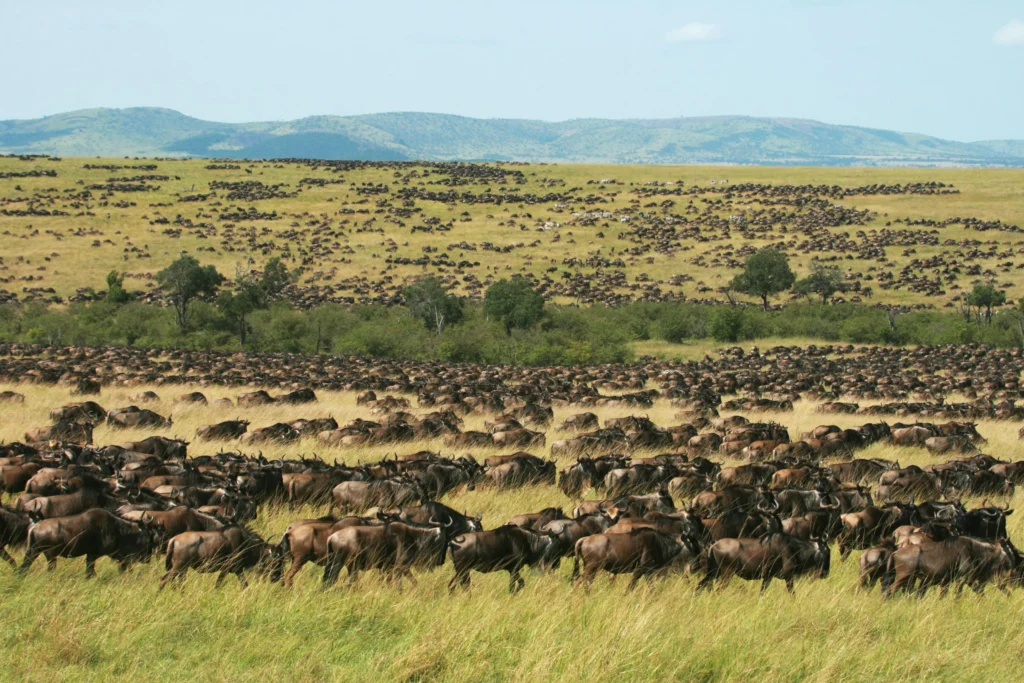
The Great Migration in Africa is not a one-time annual event. It is an endless, circular, year-round journey across more than 1,800 miles of savanna in Tanzania and Kenya. While many travelers assume the migration only happens between July and October during the river crossings, the mega-herds of roughly 1.5 million wildebeest, 300,000 plains zebras, and hundreds of thousands of gazelles are in constant motion.
Because the herds never stop moving, deciding where and when you should travel depends entirely on the specific chapter of the journey you want to experience.
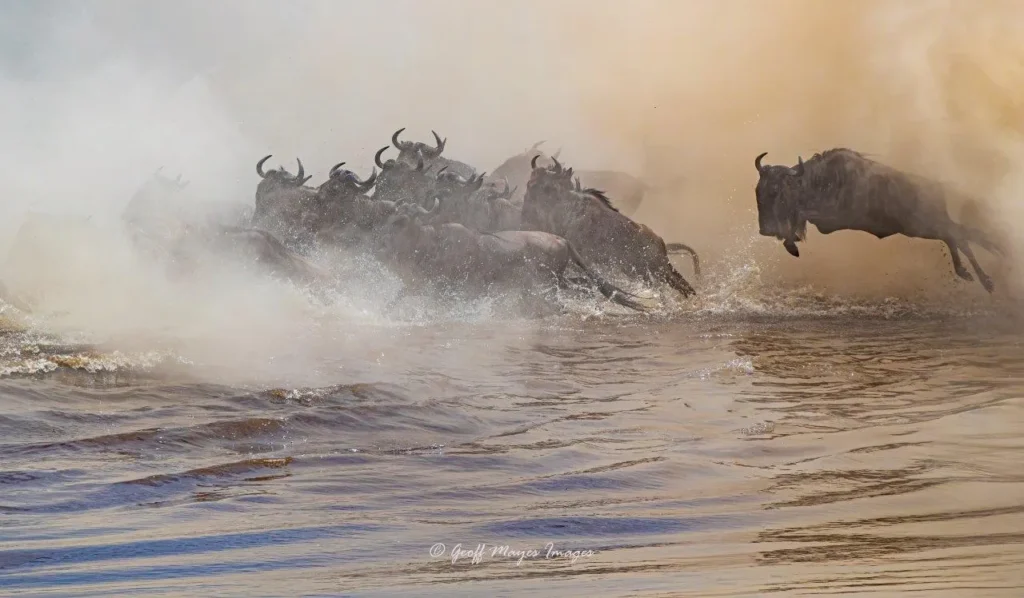
If you travel between January and March, we will position your camp in the middle of half a million newborn calves on the open plains of southern Tanzania, watching big cats hunt in broad daylight. If you join us between July and October, we will station you along the riverbanks of Kenya’s Masai Mara to witness the dust, noise, and drama of the river crossings.
Below is an honest, month-by-month look at how the migration actually moves, what road and weather conditions you will encounter, and how to make sure you arrive in the right park at the right time.
The Great Migration: Definition and Ecological Cycle
To understand what the Great Migration is, you have to look at the rainfall patterns across the contiguous Serengeti-Mara ecosystem.
By ecological definition, the Great Migration is the largest synchronized overland mammal migration on Earth. Driven by seasonal rainfall, nutrient gradients, and the scent of fresh grazing, roughly 1.5 million wildebeest, 300,000 plains zebras, and hundreds of thousands of gazelles move in an endless circuit between Tanzania’s Serengeti National Park and Kenya’s Masai Mara National Reserve.
The herds require calcium-rich and phosphorus-rich grasses to support lactation and build bone strength in their young. Because volcanic soils in the southern Serengeti produce mineral-dense grazing following seasonal rains, the herds travel south to give birth. Once those plains dry out, survival instinct pushes the herds northwest and north toward the permanent water systems of the Mara and Talek Rivers in Kenya.
The 365-Day Cycle of the Great Migration in Africa
To make planning simple, we have combined the biological phases of the migration with our travel calendar. Below is exactly where the herds are, what they are doing, and what safari conditions you can expect during every chapter of the year.
| Phase & Timing | Primary Location | Wildlife Events & Migration Behavior | Safari Travel Conditions | Movement Direction |
| Phase 1: January to March | Southern Serengeti & Ndutu (Tanzania) | Peak calving season and resident nursery herds on the open volcanic plains. Heavy predator action from lions and cheetahs. | Dry, warm, peak season with clear views. Off-road driving permitted in Ndutu. | Herds move northwest as southern grazing depletes. |
| Phase 2: April to May | Central Serengeti to Western Corridor (Tanzania) | Massive moving columns and the early buildup of the breeding season. | Long rains turn black cotton soil slick. Lowest annual lodge rates. | Herds push toward the Western Corridor river systems. |
| Phase 3: May to June | Western Corridor & Grumeti River (Tanzania) | The chaotic peak mating rut and exclusive, fragmented Grumeti River crossings. | Transition to dry season. Low vehicle crowds and great exclusive tracking. | Herds push north toward permanent border water sources. |
| Phase 4: July to October | Northern Serengeti & Masai Mara (Kenya & Tanzania) | Dramatic, multi-directional Mara River crossings and intense apex predator action. | Peak dry season. Highest crowds, requiring bookings 8 to 12 months in advance. | Short rains in the south trigger the return journey. |
| Phase 5: November to December | Eastern & Central Serengeti (Tanzania) | Rapid southward trek across the Lobo and Seronera plains to chase fresh grass shoots. | Brief afternoon rains, lush greening plains, and great shoulder-season value. | Cycle resets on the southern plains for the next calving season. |
What the Guidebooks Miss: Month-by-Month Field Insights
While our calendar table outlines the general route, planning a successful safari requires understanding how weather, animal biology, and terrain interact on the ground.
Below are the key field realities our driver-guides prepare for across each phase of the journey.
1. January to March: The Calving Grounds (Southern Serengeti & Ndutu)
- The Biological Reality: Calving is not spread evenly across the three months. The true peak happens in February, when approximately 8,000 wildebeest calves are born each day over a concentrated two-to-three-week window. More than 500,000 newborns hit the ground almost simultaneously, an evolutionary tactic designed to overwhelm predators.
- Terrain & Guiding Edge: Most of the Serengeti features sticky black cotton soil that traps vehicles after rain. Ndutu is the major exception. Built on porous volcanic ash from the Ngorongoro highlands, the ground remains firm even during wet spells. This allows our 4×4 Land Cruisers to legally track off-road in designated zones, placing you meters away from hunting cheetahs and lion prides without getting stuck.
Planning Tip: Pair these plains with the Ngorongoro Crater on our dedicated Tanzania Serengeti Migration Safaris.
2. April to May: The Long Rains & Moving Columns
- The Biological Reality: This is the migration in pure motion. The herds leave the depleted southern pastures and stretch into unbroken, miles-long columns heading northwest through the Seronera Valley toward the Western Corridor.
- Terrain & Guiding Edge: This is the heart of the long rains. River crossings swell, and standard overland routes become challenging. Minivans struggle severely in these conditions, which is why our fleet relies strictly on custom 4×4 Land Cruisers fitted with high-clearance suspension and mud-terrain tires.
Planning Tip: For travelers comfortable with an afternoon thunderstorm, this window offers five-star luxury camps at 30% to 50% below peak rates, alongside empty park tracks.
3. May to June: The Western Corridor & The Realities of the Grumeti
- The Biological Reality: Research confirms that the frantic peak of the mating rut happens between May and June, not earlier. Over four chaotic weeks, competing bulls battle head-to-head to establish temporary breeding territories, creating an echo of grunts and dust that carries across the plains.
- The Grumeti River Truth: Guidebooks often portray the Grumeti crossing as a direct twin of the Mara River, but the physical structure is very different. The Grumeti is wider, shallower, and features gentle banks rather than sheer drop-offs. By June, depending on seasonal rains, parts of the river frequently break into smaller pools. The animals cross rapidly, making sightings more scattered than the dramatic Mara crossings. However, massive Nile crocodiles are resident here, and the area provides unmatched exclusivity with almost zero vehicle crowding.
4. July to October: The Mara River Crossings & The Border Reality
- The Back-and-Forth Truth: The single biggest misconception first-time travelers have is that the herds cross from Tanzania into Kenya once, stay for three months, and cross back. In reality, wildebeest do not recognize international borders. The Mara River loops through both the Northern Serengeti and Kenya’s Masai Mara National Reserve. The animals track localized rain storms; if rain falls south of the border in August, a herd that crossed into Kenya on Tuesday will turn around and plunge right back into Tanzania on Wednesday. Crossings happen back and forth continuously throughout this window.
- Escaping the Vehicle Clusters: Public crossing points in the national reserve can become congested with dozens of safari vehicles. To avoid this, we station our guests in private conservancies like Mara North, Olare Motorogi, or Naboisho. These conservancies enforce a strict limit of one guest bed per 350 acres and cap viewings at five vehicles per predator sighting, while still granting you daily access to the main river points. You can secure these conservancy bases on our Kenya Wildebeest Migration Safaris.
5. November to December: The Southward Trek
- The Biological Reality: As the short rains touch the southern plains, fresh, mineral-rich grass shoots begin to sprout. Triggered by the scent of moisture, the herds leave the Mara and move rapidly south through the eastern Serengeti (Lobo) back to Seronera.
- Terrain & Guiding Edge: This movement is fast-paced and fluid. Unlike the slow grazing of February or August, herds can cover significant mileage in a single day.
Planning Tip: Late November to mid-December is an exceptional shoulder window. You bypass the peak season surcharge, enjoy clean, dust-free skies for photography, and encounter plenty of healthy resident game before holiday peak rates begin around December 20.
When Is the Great Migration in Kenya, and When Is It in Tanzania?
Because the migration is a continuous loop across two countries, travelers often get confused about which borders the animals are crossing and when. The simplest way to understand the calendar is to look at how much time the herds actually spend in each country.
When Is the Great Migration in Kenya?
The Great Migration is in Kenya for roughly three to four months of the year, typically from mid-July through late October:
- The Arrival (Mid-July to August): The advance herds begin arriving from northern Tanzania, gathering on the southern banks of the Mara and Talek Rivers. August is usually the most volatile month for major river crossings inside the Masai Mara National Reserve.
- The High Pasture Window (September to October): The herds disperse across the open savannas of the reserve and neighboring private conservancies, feeding on lush grasslands while contending with resident lion prides, leopards, and cheetahs.
- The Departure (Late October to November): As the grass is grazed down and the first short rains begin falling across the southern Serengeti, the herds consolidate and begin marching back south across the border into Tanzania.
Kenya Planning Takeaway: If your travel dates fall strictly between mid-July and mid-October, Kenya is your primary destination. If you want to avoid the vehicle congestion at public river crossings, explore our Kenya Wildebeest Migration Safaris to base yourself in lower-density private conservancies.
When Is the Great Migration in Tanzania?
The Great Migration is in Tanzania for roughly nine to ten months of the year, spanning November through July, with herds present in the northern sector through October as well:
- The Calving Season (January to March): The mega-herds settle across the short-grass plains of the southern Serengeti and the Ndutu area. Over 8,000 calves are born daily during the February peak, drawing intense predator activity across wide-open, volcanic terrain.
- The Northwest Trek & Rut (April to June): The herds move through the central Seronera valley and spread into the Western Corridor. May and June mark the peak mating rut and crossings of the Grumeti River.
- The Northern Push (July to October): While hundreds of thousands of animals enter Kenya, substantial portions of the mega-herds remain in northern Tanzania around Kogatende, crossing the Mara River within Tanzanian territory.
- The Southward Return (November to December): The herds stream rapidly south from the border through eastern Serengeti (Lobo), heading back toward the central plains.
- Tanzania Planning Takeaway: If you are traveling between December and June, Tanzania is the only country where you can see the migratory mega-herds. You can track these movements across multiple seasons with our Tanzania Serengeti Migration Safaris.
Country-by-Country Timing at a Glance
| Country | Active Migration Months | Core Geographic Areas | Defining Wildlife Experience |
| Kenya | Mid-July to late October | Masai Mara National Reserve, Mara North, Olare Motorogi, Naboisho | Dramatic Mara River crossings and dense big cat hunting on compact savannas |
| Tanzania | November to July (and year-round in Northern Serengeti) | Southern Serengeti (Ndutu), Western Corridor (Grumeti), Central (Seronera), Northern (Kogatende) | Synchronized calving season, vast moving columns, open-plains predator tracking |
If your travel window falls during the July to October overlap, you have the option to witness both sides. Because the herds cross back and forth across the border chasing localized rain storms, a Kenya & Tanzania Combined Safari gives you front-row access to the entire river system on both sides of the frontier.
Frequently Asked Questions About the Great Migration in Africa
Can you predict the exact day of a river crossing?
No. Wildlife movements are governed by weather and animal instincts. Herds may gather along the riverbanks for days, spooked by crocodiles or lurking lions, before crossing in a few minutes. Spending at least three to four full nights in the Mara or northern Serengeti provides the best probability of catching a crossing.
Is the Great Migration worth seeing outside the July to October window?
Yes. The calving season from January to March in the southern Serengeti offers just as much drama. The sheer volume of animals on the short-grass plains, combined with continuous predator encounters, makes it a premier wildlife season with far fewer vehicles than the river crossings.
How far in advance should I book?
For peak migration crossings (July to September) and the calving peak (February), book 8 to 12 months in advance. Tented camps and safari lodges situated along crossing corridors are small (often only 10 to 20 rooms) and fill up quickly.
Well-positioned camps along the migration corridors fill up months in advance. Connect with us today to secure your custom 4×4 Land Cruiser and reserve your spot on our next Kenya Wildebeest Migration Safari.